Wednesday, August 17, 2011

An Unexpected Travel Highlight: Soweto

For anyone who has seen the movie District 9, picturing Soweto is going to be easy. Just imagine the same tin shacks, dirt roads and crowded conditions. There's just one difference: instead of aliens, picture people.

Since I decided to come to South Africa, a trip to Soweto was high on my "must-do" list. Home to an estimated five million people, Soweto - which stands for South Western Townships - is a city in itself, containing the history of a life-changing uprising, the street which has been home to two Nobel Peace Prize winners (Nelson Mandela and Archbishop Desmond Tutu), four different styles of houses, and some of the most amazing people you will ever meet.
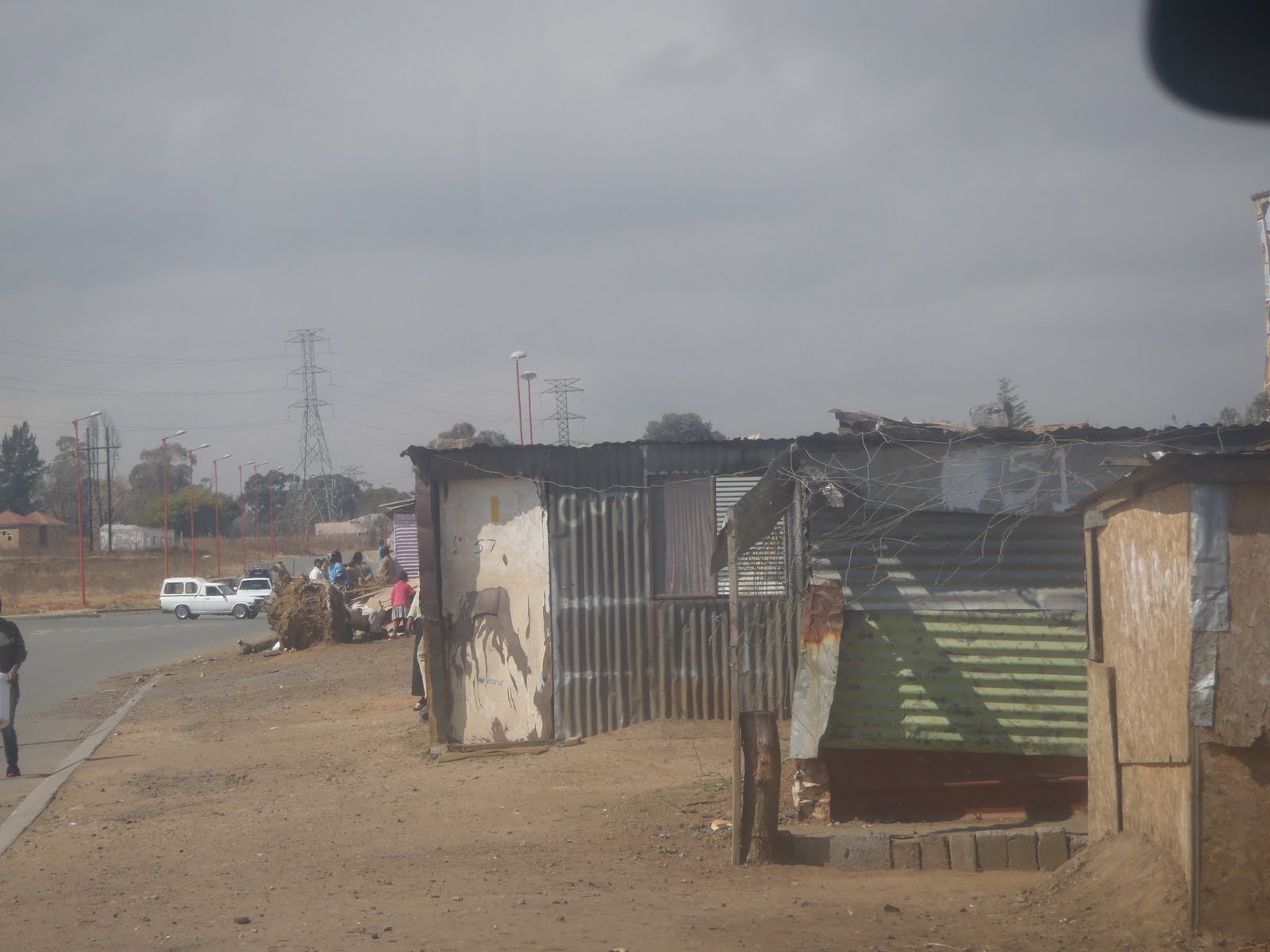
Like I've said before, my preconceived idea of the townships were a bunch of tin houses stacked on top of each other, and hard-done-by people in the streets. I pictured a falling down, miserable place.

I'm happy to say that Soweto has proven me wrong.

I'm not saying that life in Soweto is a cake walk. Every day, those people face hardships that I can't even comprehend. Food and water shortages, HIV/AIDS, little government funding and unsanitary conditions are just a few. Still, I was absolutely blown away by the smiles I saw coming from the Sowetan people. The children waved from the streets, the adults invited us into their homes, and the attitude was one of hope.

The tour of Soweto began at the Hector Pieterson Memorial and Museum. This museum is dedicated to the uprising among Sowetan schoolchildren in 1976. The students did not want to learn Afrikaans at school, and formed a protest. It began with marching and singing protest songs, but upon the arrival of the police forces, it erupted. Students threw rocks, and police shot guns. The first casualty was a thirteen-year-old student named Hector Pieterson.

This small museum is laid out in a simple yet poignant way. Photographs and small blurbs about each event leading up to the riots line the walls upwards, until the top floor, which is dedicated to the aftermath. The footage shown around the museum is unbelievable. I had never even heard of the Soweto Uprising before arriving in South Africa, and it was incredible to see documentation of such a powerful event, as well as standing in the very spot where Hector Pieterson had died.

I admire the dignity and pride that the people of Soweto have maintained. From the museum to the streets of the township itself, past the former residence of Mandela to the current residence of Archbishop Tutu, the whole area had a vibrant, forward-moving feel, both through the developed streets, and the poorest of the poor.

Because many of the people in Soweto live in extreme poverty, they felt that they had nothing to lose by inviting us into their homes, and showing us how they lived. I thought about the walled-off homes in the suburbs compared to the openness and sense of community I felt in Soweto.

I liked Soweto better.

Not all of the houses in Soweto are the same. The "bank houses" are two bedroom houses, which people get when they are able to pay the bank for their homes. These houses, while small, and by no means luxurious, don't actually look so bad! The "matchbox houses" and "elephant houses" are smaller, but still have somewhat solid walls, doors and windows. The elephant houses have big, clay roofs, which is where the name comes from.

The slums (the District 9 houses) are a famous visual of Apartheid. These were the houses that we chose to visit. One of the women, accompanied by her three beautiful children, led us into her home with a big smile. The house was tiny - and that is an understatement. The tin roof and tin walls had gaps between them, the bed (only one) was shoved in one corner, a propane stove for heating and cooking was in the centre of the room, and there was a small desk in the other corner. That was it.

I can't believe that people all over the country are living like this. The people of Soweto showed no sign of bitterness or contempt. They seemed genuinely pleased that we were willing to step outside our comfort zone and into theirs to learn about their lifestyle. This really had an impact on me. I'm so glad I had the opportunity - privilege if you will - to get a glimpse of the life in the townships firsthand, and meet some of the amazing, beautiful people that live there.

On the way out of Orlando (in Soweto), we drove by two huge cooling towers, which had been painted with murals and converted into a bungee jump. Mthandeni offered to stop if anyone wanted to give it a go. Maybe next time.

Seeing Soweto, its history and its people was one of the biggest travel highlights of my life. If you are in South Africa, do not, I repeat DO NOT miss Soweto. It was surprising, heartbreaking, and hopeful all at once. Walking into a darker part of a country's lifestyle is essential to understanding another very different aspect of life.

Questions? Comments? Criticisms? I'd love to hear them all!
the-wanderingjew@hotmail.com

The Essential Johannesburg in One Day


Since I only have two days in Jo'burg before I head off to Kruger Park, I had a plan to jam-pack some of the main points of interest into my two day stay. The plan was to go to the Apartheid Museum on the first day, and visit Soweto on the second. Unfortunately, when I looked at the prices for each individual tour, I almost passed out. Fortunately, there was another option: do a city tour of Jo'burg, the Apartheid Museum and Soweto all in one day...for a fair bit cheaper. I was also lucky enough to meet Erika, another solo female traveller (it is a thing), and it was cheaper for two! So we signed up.

Our guide Mthandeni (say it five times fast) met us at 7:45am. He is easily one of the most amazing people I've met so far, with one of the most incredible stories. Originally from the KwaZulu-Natal province, he lives in the shacks in Soweto with a wife and two children. He told us that by next year, he will receive his government house, which is a major step up. I wish him the best!

After picking up two more people who were joining the tour, Mthandeni welcomed us all wholeheartedly to South Africa, and then explained about the Cradle of Humankind: the world's oldest human fossils were found in this area, and therefore humankind may well have originated around Jo'burg and Pretoria. He welcomed us home.

Before officially starting the tour, he told us about all of the different sights and places around Johannesburg, such as the original gold mine, the crocodile farm, and various different historical sites-turned tourist haunts. It was incredible how much he knew about the area and its surroundings! If you ever need to know anything about South Africa, ask this guy. He'll tell you.

The first stop on the tour was Rosebank, one of the wealthy suburbs of Johannesburg, just north of the City Centre. It was amazing to see these huge mansions surrounded by high walls, razor wire, electric fencing, and some of the abysmally large houses even had their own security guards! It was sad to see that the fear of the outside world was driving these people to hold themselves prisoner in their own homes.

After Rosebank, we drove by the house where Nelson Mandela now lives! For security reasons, we couldn't actually stop in front of the house. Shame we couldn't knock on the door and say hi.

Next, we headed to the Constitutional Court, where we learned that South Africa had eleven official languages, which were all represented on the front of the building. Mthandeni urged me to try to pronounce some words in Xhosa (the "clicking" language), and then gave me a six-out-of-ten score! I was very proud.

Since in African culture, issues used to be resolved under the shade of trees, the inside of the courthouse was designed to look as if it were underneath trees. It was a beautifully designed building, and I liked seeing all of the different cultures represented. Some of the walls were built from the old fort, which had been a prison for a while. The contrast of these bricks mixed with new walls represented the past and future of the nation.

After that, we headed to downtown Johannesburg! Mthandeni promised that he would offer superior protection, and explained that his left fist was the "hospital option", and the right fist was the "grave option" and any assailants could take their pick. I felt very safe.

Downtown Jo'burg is definitely not as vibrant and attractive as Cape Town. It's mostly big buildings and rather dirty streets. It has the look of a corporate city, and overall, it's a little beat. However, some of the side streets had a certain charm. We got to look into one of the older stores in the area, which sold hooves, dried skins and herbs to cure whatever ails you. It was very cool in a rather morbid sort of way.

Based on what I had seen in the media before I came, I had expected downtown Johannesburg to be terrifying, full of leering locals, and I wondered if a bullet-proof vest would be a requirement. Maybe it was simply because I was on a guided tour, but I really didn't feel threatened or even sketched-out at all. Everyone I saw was just going about their business, and nobody seemed malicious or spiteful at all. I did notice that there weren't many white people out and about. It was interesting to be a part of a physical minority.

The last stop on the city tour was the "Top of Africa", located on the top floor of the Carlton Centre. You take an elevator up 50 floors, and get an amazing view of Johannesburg from all angles. It wasn't a part of the tour, but it only cost R20 (about $3) extra. Why not?

The next stop on the tour was the infamous Soweto. More on that later.

After Soweto, we headed to the Apartheid Museum. The museum starts out by issuing you a ticket, which randomly classifies you as "white" or "non-white".

For the record, "non-white" refers to any black, Indian, Asian, and mixed-race people.

The exhibit begins by giving a background on how Apartheid government came to be in the 1930s and 1940s. The (white) government wanted to give poor Afrikaaners a chance to get work, and so they moved all of the non-white citizens to their own areas (townships), so that they would not "interfere".

The museum, set up like a giant maze, takes you through the beginning of Apartheid, life in the townships, resistance groups, and then more horrifying exhibits, such as life for non-whites during this time, torture and imprisonment. There are original signs hanging on the walls saying "Europeans only". To be honest, it wasn't all that different from Nazi Germany, was it?

I learned about the "passbook" that all non-white citizens had to present in order to leave the townships. If they failed to present this, they would be arrested. It's really no wonder that people acted desperately by mugging wealthy citizens and other desperate measures, contributing to Johannesburg's high crime rate.

Many white families had black "servants" who would cook, clean and look after the children. Of course, the servants were not allowed to "love" the children...just take care of them objectively, as if that was possible.

Many activists, such as Mandela, Robert Sobukwe, and Steve Biko were tortured via electric shocks and beaten, and thrown into prison for resisting the Apartheid government.

The uprising in Soweto was a turning point in politics. Many non-white citizens, from schoolchildren to adults, rallied together against oppression. Many of them were killed or injured in conflict with police.

The museum shows a twenty-minute film, which shows footage from actual political rallies, and interviews with people who were involved. It was incredible to see such passion and violence. This twenty-minute documentary really brought to life what had been happening in a gripping, disturbing, evocative way.

The Apartheid Museum effectively conveys its message; it's hard to take all of the information given in the museum. It shows that Apartheid was not only unjust and full of hardship, but evil. Multimedia, written words and photographic presentations of this time - not very long ago - really paint a saddening, eye-opening, yet hopeful picture. I feel that I understand much more about Apartheid and the people involved than I did before coming to South Africa.

The final display in the museum shows Mandela's release in 1990, and the 1994 election which changed the world. The exit of the museum is lined with words like "responsibility", "freedom" and "diversity", as well as a small, serene pool. What a trip. The ending really gives a strong message of hope about the country's future.

Though the effects of Apartheid are far from forgotten, the optimism of the people in the country is evident. Despite a horrible past, I have felt safe in the country. The locals are pleased that I'm interested in their culture and history, and I feel honoured that they have welcomed me, and willingly told their stories.

Sometimes compassion and understanding - "ubuntu" here - can make all the difference. Respect and love for others drives the future of any country, and the South Africans I've met have shown this more than anyone. I highly recommend the Apartheid Museum. It's hard to look at, but essential to our understanding of South Africa's history, and the history of many people and cultures all over the world.

To read about Soweto, check the most recent blog.

Questions? Comments? Criticisms? I'd love to hear them all!
the-wanderingjew@hotmail.com

Sunday, August 14, 2011

The Last Two Days in Cape Town

Believe it or not, my time in Cape Town is nearly done. Tomorrow morning I'm heading to the airport to fly to Jo'burg for the next part of my trip. I can't believe that my week in the Mother City is over...I've grown pretty attached. I hate to pick favourites, but Cape Town is definitely up there, and it's going to be hard to leave.

Yesterday, the weather was still a little chilly, but it had stopped pouring, so I signed up for a trip to the Cape Point, which is the absolute south-westerly point of the African continent. The tour started at 8:30 in the morning, and continued on right until almost 6:00. The Peninsula is a big place!

Our first stop on the tour was going to be Hout Bay, whose main claim to fame is the seal colony. On the way out, we drove past the Twelve Apostles of Table Mountain, and past the Atlantic Ocean, where the wind was creating the biggest swells I've ever seen. I still can't believe how stunning the scenery all around Cape Town is. Every way you turn your head, there's a beautiful landscape, just waiting to be ooh-ed and aah-ed over.

Just before Hout Bay, the first stop, we drove by Camps Bay, which is one of the most expensive communities in South Africa. Shortly down the road, we passed a township. I'm not sure I'll ever completely get used to seeing massive wedding-cake houses next to tin shacks. It's a bizarre and upsetting contrast.

At Hout Bay, t was an extra R50 to take a 45-minute ferry tour to Duiker Island, but I decided to give it a go. Unfortunately, out of the harbour, the waves were putting on a Titanic-esque show, and we had to turn around. I'll be honest, I'm getting a little sick of boats. I was a little disappointed that we didn't see the seals on the island, but on the way into the harbour, there were a bunch of them lazing around on the docks, and two of them were halfheartedly fighting. This made up for it. At one point, a man on the dock was trying to shoo the seals away from his boat. I was really hoping one of them would chase him down. No dice.

After Hout Bay, we drove past Chapman's Peak, where we stopped a few times for photo-ops. Chapman's Peak looks down over the ocean and the Cape of Storms. I learned that over 1, 000 shipwrecks had occurred on this coast (hence the name).

The next stop was definitely a highlight: Simon's Town, a cute little Navy base-turned seaside village. It had a lovely, relaxed atmosphere, frequent whale sightings...and it's also five minutes away from Boulders Beach, home of the infamous Jackass Penguins!

The penguins were definitely one of the high points of the tour. There were tons of them just hanging out on the beach, lying in the bushes, and a few of them running down the shore! The water washing over the boulders was stunning, and I couldn't help thinking that they had scoped out one of the best places to live. They're quite small, and very tempting to pet, although the signs warning of being bitten made me reconsider.

After the penguins, we drove into the Cape of Good Hope Nature Reserve, and were given the option of riding seven kilometres to the visitors' centre for a picnic lunch. Everyone took advantage of the biking option. Although the ride was mostly flat, the strong, freezing headwind and spitting rain made the few uphills quite hard, and the visibility wasn't great. I rode into the visitors' centre rather stiff, but soon forgot at the sight of the lunch. There was awesome bread, vegetables, pasta salad, juice...should I go on?

Then, it was the moment I had been waiting for: another seven kilometre ride to the Cape of Good Hope itself! It had stopped raining, and this ride didn't seem so intense. On the way in, we rode right by a family of baboons and two ostriches right on the beach! I arrived at the Cape of Good Hope by bicycle! I didn't see that one coming.

The Cape of Good Hope is easily one of the most beautiful locations I've seen on my trip. The waves were gigantic, and the ocean looked like a giant washing machine. This is the point where the Indian and Atlantic Oceans meet. There were boulders, and the sites of past shipwrecks all over, and of course, the famous "Cape of Good Hope" sign. I, of course, did the typical tourist thing and got my picture taken...holding a Canadian flag no less!

The next destination was the Cape Point, with the old and new lighthouses. We took a twenty minute walk up to the lookout - which took the cake for best view of the Peninsula - and then loaded back in the van to head back to Cape Town. It was definitely a long trip, but I feel like I learned quite a bit about the area, and saw some of the most famous and incredible sights in the world. Props to our guide Neil, who was like a walking, joking textbook on Cape Town! If you're ever in Cape Town and want to see the Peninsula, go through Daytrippers. I definitely got my money's worth!

Today, the weather had turned right around, and once again, there were clear skies. This meant only one thing: I was going to hike Table Mountain! For the past few days, the weather has been rather unforgiving, and I was worried that I wouldn't be able to hike the mountain. If there's major cloud cover, there's no point in going to the top, because there are no views. I also had yet to meet a single other person who was interested in the hike. Since I had heard stories about muggings at the base of the mountain, and - worse - people getting lost or dying due to treacherous conditions, I didn't think going alone would be the world's best idea.

I made an enquiry about a hike through Abseil Africa on Monday. Unfortunately, they needed at least two people to confirm the hike. It wasn't looking good. Luckily for me, Lenore, who works in the office there, had my back. She referred me to another guide, who was willing to take me up the mountain! She really went out of her way to make this happen for me, and I am so grateful!

This morning, at 8:30 (I'm sensing a theme), I was picked up, and we were off! I learned that the Cable Car was closed today, due to winds over 30 km/h. This meant that whether I liked it or not, we were hiking up and down. Fine by me!

The route we took was via Platteklip Gorge. I was fully expecting this hike to be Grouse Grind-esque, with lots of high-stepping and holding onto ropes and whatnot. It was definitely not a walk in the park by any means. The whole way up, you have to maneuver your way over big sandstone rocks, like a naturally-placed staircase. However, despite the careful-footing and extremely steep route, it didn't actually seem too terrible. The worst part for me was the wind; there were a few moments where I was sure I was going to be blown off the mountain, all the way to Robben Island. My hands were absolutely frozen, but after a good hour and a half of climbing, we made it!

The "Tablecloth" (cloud cover that often sits on top of the mountain) didn't appear today because of the wind, and the views from the top were spectacular. I had a perfect bird's-eye view of the City Bowl, Camps Bay, Clifton Beach, Hout Bay, and even a fair ways down the Peninsula! Although the wind was brutal, and therefore I didn't spend too long on the top, I was blown away (har har) by the views. I'm so, so glad Binny was willing to do the hike, because it really made my trip! Considering the obstacles in the weather and finding willing participants to hike, I consider myself very lucky that I got to do this on my last day in this amazing city.

Surprisingly, I found going back down the mountain harder than hiking up. Because of the gale-force winds and all the rocks, you had to pay very close attention to each footfall, and each stone step is far enough apart that it's quite a step down, and this was not a place I wanted to take a fall! My knees and hips were a little sore at the end, and my hands were pretty much petrified. Would I ever do it again? Absolutely.

I was very proud of myself for hiking up and back again. From now on, whenever I think of Table Mountain, I'll remember that I was on the top of the table! I also learned that the wind is the main reason the city isn't covered in pollution. They call it the "Cape Doctor".

I'd recommend this hike to anyone! There's a huge sense of fulfillment when you reach the top, and apparently it's not always so windy. Also, I saw a man hiking in bare feet, a bunch of teenagers in Keds, and a woman in a skirt and dress shoes hoofing it to the top. So if they can do it...

For the record, as excited as I am for the rest of my trip, I'm now feeling very bummed out about leaving this city. Cape Town, I love you!

Questions? Comments? Criticisms? I'd love to hear them all!
the-wanderingjew@hotmail.com

Friday, August 12, 2011

What Mister WWOOFer Does on Her Days Off

As I was skimming over the last few blogs I've written, I noticed that I had missed a major part of my trip! My days off from WWOOFing! I hope you don't think that I was worked to death, and never caught a break, because this couldn't be farther from the truth. As a matter of fact, some of the major highlights of my trip took place on the weekends, between painting, building, and baboon chasing.

On Farm 119, weekends are dedicated to getting as much sleep as you possibly can, and usually, only a half-day's work is done. My first weekend there, it was pouring rain, but Kevin and Mila were still game for a hike to the Drupkelders, which is about a half-hour away from the farm. Although it was more or less a torrential downpour, it wasn't actually that cold out, so I decided to join in.

Since the Drupkelders is in the Knysna Forest, it wasn't all that wet once we got under the shelter of the trees. The Knysna Forest has a mysterious, wild feeling that I've never experienced in Canada. The wilderness of it sucks you right in. The first little bit of the hike is flat, but after a while, you reach a downhill, which carries on for a few kilometres. At one point, there's a rope to hold onto as you traverse down the hill! It was quite slippery in the rain, and watching your footing is a must, unless you want to get muddy.

All of the sudden, the hill comes to an end, and you find yourself standing in a huge gorge, which surrounds a river, which is apparently a swimmer's nirvana in warmer weather. There are vines hanging down the sides of the gorge, and the sound of the rushing river combined with the rain definitely gave me the "African Wilderness" idea.
The entire landscape of the Drupkelders was breathtaking, and taking it all in while being sheltered by the gorge was the perfect thing to do on a rainy Sunday. For the record, in warmer, drier weather, the Drupkelders gorge would have made for amazing bouldering!

The hike back up the hill was a little bit more challenging, as the stones were soaked, and I tended to slip every couple of steps. However, I'm still in awe of how beautiful the Drupkelders were...and they were only half an hour away from where I lived! How lucky is that?

I think that I'm still a little bit damp from that hike, and three weeks later, I have a pair of socks that still hasn't quite dried out. However, the scenery of the place was worth soaking through to the bone. Anyone in Rheenendal: take an afternoon and hike to the Drupkelders!

A quick word of caution: never leave a Malarone tablet in your pocket if there's a chance it might get wet, as it will dissolve into yellow mush which gets all over everything, and is a pain in the ass to wash off.

The main event, however, came the following Saturday. I had heard rumors about the Rastafari Earth Festival, and secretly had my fingers crossed that we would go. I lucked out again, as Kevin and Tanya asked me if I would be interested in attending the Knysna Rasta Fest. Uh, yes please!

Although the event didn't start until that evening, I went early with Kevin. He wanted to take some shots of the Knysna Heads before the sun went down, and I went along for the opportunity. For the record, do not miss the Knysna Heads! Watching the sea crash up and down over the rocks while the sun was just starting to set was probably one of the most stunning landscapes I've ever seen in my life. I helped Kevin with some of his shoot...by that I mean I held up a lamp for background lighting. The effect was quite magical.

Afterwards, we headed to the Festival. I expected it to take place right in town, so you can imagine my surprise when we drove into the Khayalethu Township, down narrow, twisting roads until we reached the House of Judah, complete with Bob Marley mural.

For the record, Knysna is home to South Africa's largest Rastafarian community; there about thirty families living peacefully in the Khayalethu Township. I had read about this before coming, but I never imagined that I would actually be entering Judah Square and partying with the community! Definitely one for the old bucket list!

Being in the township only added to the experience for me. I noticed that within the township, there was acutally a fair bit of diversity. My preconceived notion of the townships were a bunch of falling-down shacks, and hard-done-by people (which I'm embarrassed to admit now). As we drove through, however, I noticed that some of the houses were actually decently equipped, the people were beautiful, wearing colourful clothing, the children played a game of soccer, and I noticed teenagers laughing around a fire. Really, this isn't all that different than how people in the white suburbs spend their Saturday nights.

All of the Rastafarian people I met were friendly; I was one of very few white people there, but I felt no judgment. The people were peaceful and gentle, giving me fist bumps (a traditional greeting in their culture), welcoming me, and offering to sell me buds of ganja the size of my head. It was a nice change to be at a gathering like that where there was no belligerence, drunkenness or brawling. Everyone was dancing to the live (awesome) reggae music, there was food and tea, and everyone was smiling and enjoying each other's company.

The Rasta Earth Festival was definitely one of the top travel experiences of my life. It was an unexpected surprise, and a deep look into a very different culture that I'm so glad I got to be a part of!

By the way, the Rastas all called me "Sista Rebecca". Just in case you're interested.

Questions? Comments? Criticisms? I'd love to hear them all!
the-wanderingjew@hotmail.com

Thursday, August 11, 2011

A Day at the Robben Island Prison Museum

I will freely admit (a little embarrassingly) that before coming to South Africa, I did not know a single thing about the country's history. The name Nelson Mandela was pretty much the extent of my knowledge, I couldn't accurately summarize Apartheid if you paid me, and I fell asleep during Invictus. In short, I am the worst.

Over the past month that I've been here, I've heard bits and pieces about the Apartheid days from the locals, and I've driven past many townships. I even spent an evening in the Khayalethu township outside of Knysna partying with some Rastas! One of the first sights I saw on my way into Cape Town was Khayelitsha: thousands of tin houses as far as the eye could see, some barely standing. Khaya is South Africa's second largest township, with over a million inhabitants. It's a city in itself, and I couldn't quite get my head around the fact that so many people were living on top of each other from day to day.

Still, I have to admit my knowledge was minimal, something I wanted to change, as I figured my love for South Africa could only deepen with greater knowledge of its history and people.

I felt that visiting Robben Island, a former prison-turned museum and World Heritage Site where many political activists were incarcerated during Apartheid would really give me some insight. I woke up to a very foggy sky and rumors of rain. I immediately panicked, because the ferry to Robben Island is known for cancelling due to rough water or bad weather, and the day didn't look promising.

I lucked out; my ferry was scheduled to leave at 11:00, and when I arrived at the Waterfront, the ferry was there, and the people at the Nelson Mandela Gateway informed me that we were set to go!

A ticket to Robben Island includes a return ferry ride to the island - half an hour each way - a bus tour around the island with commentary, and a tour through the maximum security prison, guided by a former political prisoner. During the ferry ride over, we did pass over some swells, but after the shark boat, it felt like a bit of a joke.

Upon arrival at the island, I learned some background information about the prison. It had been in operation since the early days of the Dutch and British occupation of South Africa. In the beginning, both men and women with mental illnesses were sent to the island and detained there. It also served as a leper colony before becoming a maximum security prison for anyone opposing the Apartheid government. Most, if not all of the inmates were black, coloured, Indian or Asian. There were many escape attempts, but very, very few success stories. After feeling the freezing water around Cape Town, and meeting the sharks firsthand, I understood why escaping was near impossible.

The prison was in operation until the early 1990s. The last prisoners were taken off the island and sent elsewhere not long after Mandela made his famous speech in 1990.

The bus tour took us around to different sites on the island I did not know about, such as the lime quarry, which prisoners were forced to dig with hand tools such as picks or spades. Because of the bright sun reflecting off the rock, many prisoners suffered partial blindness after time. We visited a church built by the lepers, and the graveyard of Irish settlers who had left their country because of the potato famine, and taken up residence at Robben Island.

The tour guide on the bus was full to the brim of information about Robben Island's history, and made jokes about all the tourists' home countries. She asked the Belgians if they had brought any chocolate, the Americans which state was better: California or Florida, me - the solitary Canadian - when hockey season started, and requested that the Dutch tourists not colonize South Africa again. A fair enough request. It was nice to start the tour with laughter from all parties.

After the whirlwind bus tour, we entered the maximum security prison, and were met by our guide, who had been an inmate during the 1980s. He told stories of his own past. He was arrested, tortured, and thrown in prison. He spent six out of eight years at Robben Island working in the kitchen. He also showed us an example of a prisoner identification card, and read the ranks of the prison: black people were at the very bottom.

I feel that having a former prisoner give the tour was ingenious; I definitely got an insiders' look at the maximum security prison! Although I never got the guide's name, I admire his bravery to coming back to a place where he faced such hardship in order to tell his story to people like me who really can't even imagine such conditions.

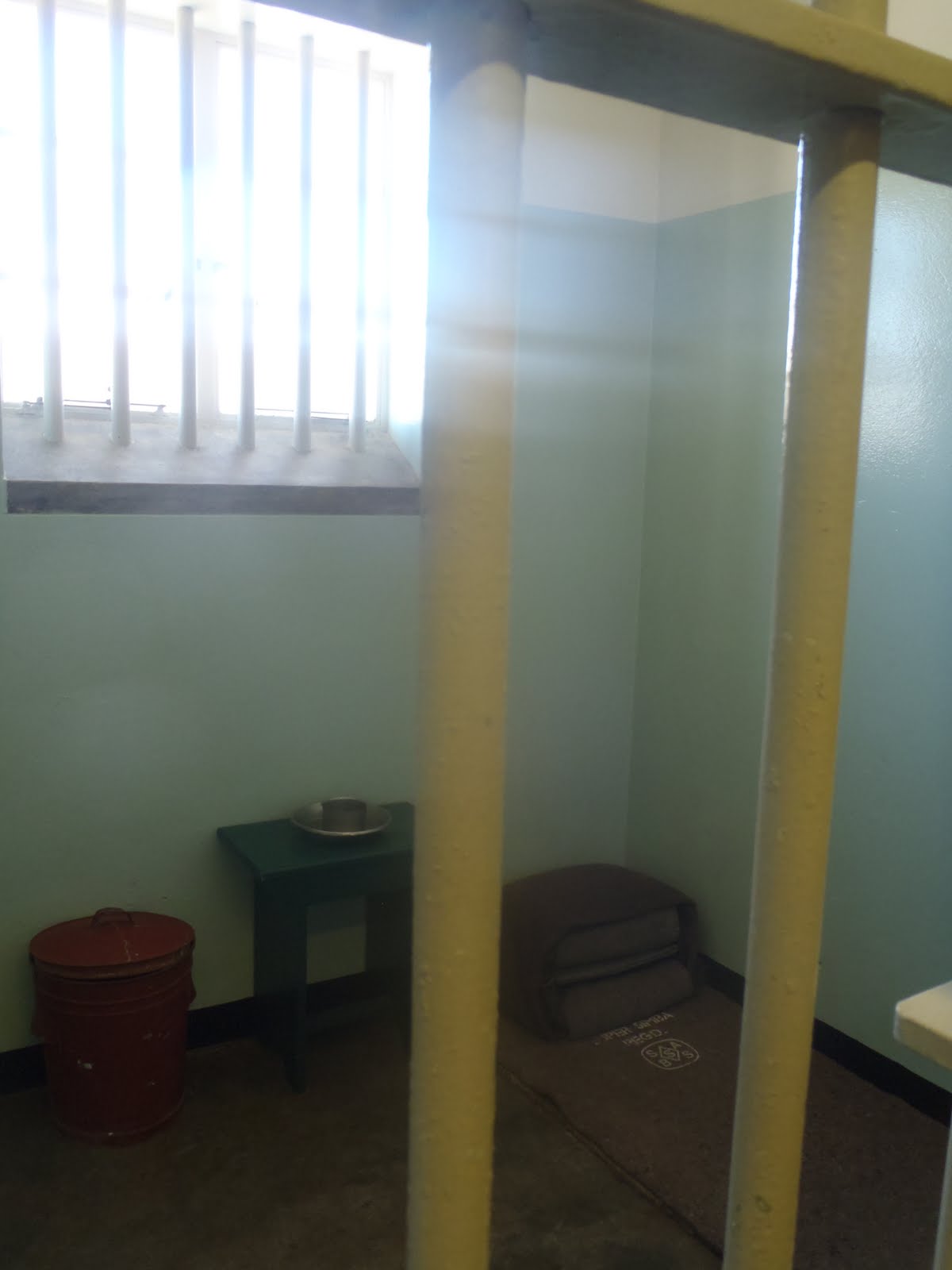
The highlight for me, almost needless to say, was walking past Nelson Mandela's former cell. It was a tiny area, among many others, which had housed leaders of opposition parties. It contained a small mat that had been used as a bed, and a bucket - in lieu of a toilet. Another highlight was seeing the pile of stones in front of the limestone quarry. This was where former prisoners held a reunion, and piled the stones in order to symbolize their experience.

One complaint I have about the tour is that we weren't allowed to get off the bus very often, and the whole bus tour felt very rushed. If we spent too long trying to take pictures out the window, the tour guide would become irritable. I understand that there was a schedule, but I personally would have liked to have time to actually experience such an amazing place before being whisked off to the next point on the tour.

Despite the atrocities and indignities suffered at Robben Island, I still felt a sense of hope as I left. I simply look at the people I have met in South Africa, and see that they are making the most of life as it is today. Our guide, who had suffered Apartheid, had come back to Robben Island, willing to share his experience, in order to educate people from around the world. The courage and optimism of the South African people is stunning.

If you're looking for something to do in Cape Town that does not involve sharks or surfing, I strongly recommend Robben Island. It's informative, unbelievable, and essential to understanding the country's stormy past. You may even spot a penguin or two.

"The journey's never long when freedom's the destination."

Questions? Comments? Criticisms? I'd love to hear them all!
the-wanderingjew@hotmail.com

Wednesday, August 10, 2011

Sand and Surf, All in One Glorious South African Day


As I type this, my arms are seizing up from excessive paddling in massive swells, and my knees are all raw from skidding down sand dunes all morning. Nevertheless, I am above and beyond happy! Since I promised my poor mom that I would not partake in any more shark-related activities, I moved on to the second phase of must-do activities Cape Town has to offer: a sandboarding and surfing combo!

Once again, Downhill Adventures completely outdid themselves, providing incredible locations, well-kept-up gear, and an amazing guide, who made the experience fun and definitely memorable. My hat's off to Jerry at Downhill! Hilarious, encouraging, patient and knows the crap out of surfing...if you ever find yourself doing this tour in Cape Town, ask for him!

At 10:00am, I arrived at the Downhill Adventures office, and learned that I was in fact, the only person going on the tour that day! Apparently in winter, not as many people sign up because they don't want to brave the cold water. I can tell you firsthand that when you're trying to maneuver through three or four foot swells in a wetsuit, you're anything but cold.

The first half of the day was sandboarding. I learned that Downhill Adventures is the only company in Cape Town that uses actual snowboards, boots and bindings as opposed to a piece of wood with foot-loops. The technique of sandboarding is similar to snowboarding. If you want more speed, stand flat on your board instead of carving with your edges. That's pretty much the only difference. However, the actual feel of sandboarding is way, way different. The sand doesn't pack down as well as snow, and if you hit a bump that you aren't anticipating, you will take a dive! The sand gets absolutely everywhere, and the guides actually rent you boots about a half-size too big to compensate for the sand!

I also found that after each run, you need to re-wax your board, or the sand will clump on the bottom, and you won't go anywhere. I found this out the hard way, as I was flying down a particularly steep dune, stopped out of nowhere, and toppled over sideways. I sort of wish I could have seen myself.

After each run, you have to walk all the way back to the top of the dune! I can't imagine doing it in the summer, as Jerry was telling stories about walking up in fifty degree heat! Although the hike to the top is rather painful, sandboarding is a total blast! Altantis, where the dunes are located, is more or less a mini-desert about forty-five minutes out of Cape Town. There is a perfect view of Table Mountain in the distance, and since today was clear, without a cloud in the sky, it felt like someone had placed a backdrop there!

After a few hours of sandboarding, we had a break for lunch, and then headed to Big Bay. Although it isn't as much of a surfer's paradise as Muizenberg, Jerry explained that it was a safer beach, the swells were more predictable, and it was shark free! This sounded good to me, as I prefer sharks from the safety of a cage.

The swells were a little bit bigger than anticipated, but I actually found this a little bit easier to gain the momentum to stand up. Yes, friends, I did stand up. More often than not. I'm surprised too.

Dragging a surfboard over massive swells, having to lift the front and jump the wave every few seconds, and then turn the board around is quite rough on the arms. Especially if you lack any sort of upper-body strength, like me! At the end of the day, I felt a bit like a wet noodle, but a happy one. Apparently South Africa boasts some of the best surfing in the world, and I'm very proud to say that I've experienced it!

The surf/sandboard combo is quite decently priced, and you bake in the sun all morning sliding down sand dunes, and then cool off in the afternoon. It's the perfect day trip, and can almost guarantee a good night's sleep. I strongly recommend it!

For the record, I'm now considering just staying in Cape Town forever and becoming a surf bum. Fair warning.

Once again, a massive thanks to Downhill Adventures for an unforgettable day!

Questions? Comments? Criticisms? I'd love to hear them all!
the-wanderingjew@hotmail.com